
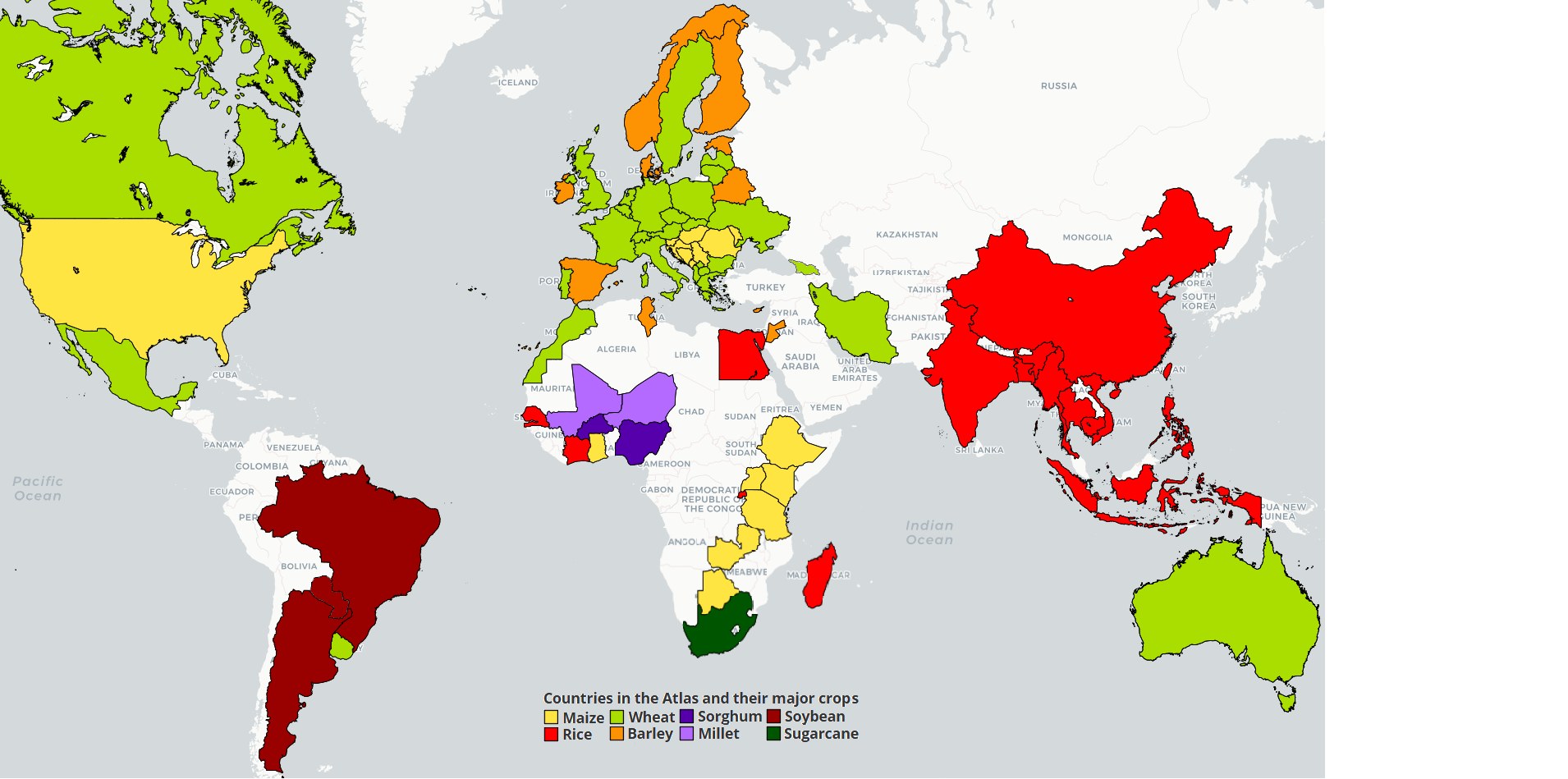
| Global Yield Gap Atlas Decision-making abilities for your next investment in agriculture are only as good as the data in front of you. This is the original and world's leading database on high-quality agronomic data with local to global relevance that covers up to 13 major food crops across 70 countries and six continents with the following data:
The data serves research, strategic decision making and local-global actions that aim to improve yield and resource use efficiency by public and private sectors. Since 2022, GYGA is featuring in the Sustainable Development Report by the Sustainable Development Solutions Network (SDSN)! Check out the 'Yield Gap Closure' indicator in the SDR 2025 here! GYGA has been developed since 2011 under the leadership of scientists from Wageningen University & Research and the University of Nebraska-Lincoln (UNL). This development has happened with collaborations with many scientists and agronomists all over the world, who took responsibility of local data collection, crop model evaluations and evaluation of yield gap estimates. Global Yield Gap Atlas has thus been developed over the period from 2011-2026, ever expanding, and adding new countries and crops, resulting in many scientific publications on methods and applications of the outcomes of yield gap analyses. In the 2026 the collaboration in its current form has ended and Wageningen University & Research is here hosting this original website and data collection. At Wageningen University & Research, we remain committed to making the legacy of the GYGA collaboration available as a public good. Data from the Atlas is available for use under the Creative Commons Attribution-NonCommercial-ShareAlike 4.0 International License. Are you interested having GYGA protocol based analysis of agricultural productivity for a crop or country? Get in touch with us: Contact Wageningen University & Research by email
|  |
 Video "GYGA in a nutshell"
| The GYGA platform - what makes GYGA a unique database?
Currently, the country by crop combinations included in GYGA account for 91%, 86%, 65% and 95% respectively, of the global rice, maize, wheat and soybean growing areas.
| Research expertise by the GYGA team The GYGA team consists of world-leading scientists on agronomy and resource use efficiency who will be happy to support you to achieve your goals. We always work in collaboration with country agronomists from reputable institutions with knowledge on production systems, soils, and climate to ensure local relevance and a strong agronomic foundation. Possible areas of future research include:
|



| Who is GYGA for? | |
| Private sector
| Public and non-profit organisations
|
| How could GYGA benefit your organisation? | |||||
 |  |  | |||
| Your go-to database platform Save your time with all-in-one platform on high quality and locally relevant data on crop yield, yield gaps and agronomic data | Strategic decision-making support Reduce risk and uncertainty in your strategic decision making with high-quality and locally relevant data | Prioritise your investments Optimise your revenue and cost-saving by using the data to prioritise investments that could give the highest return and resource use efficiency | |||
 |  |  | |||
| A starting point to close yield gap in the field Serves as a foundation for further studies on how to close yield gaps in the field and determine relevant local actions | Get a more accurate investment analysis Perform ex-ante and ex-post potential impact assessment of an investment | Analyses on food security, land use and resource use efficiency Undertake analyses on food security and potential areas for sustainable intensification to optimise your return. | |||
| Achievements | |||
 |  |  |  |
| Invites 60,000 visitors every year | Over 19,000 data downloads per year, averaged over the past 5 years | Produced dozens and triggered hundreds of highly-cited publications over the past 10 years | Included as the Yield Gap Closure indicator for the assessment of SDG2 by UN-SDSN |